Gaming is Love Unlimited: More Than Just a T-shirt Design
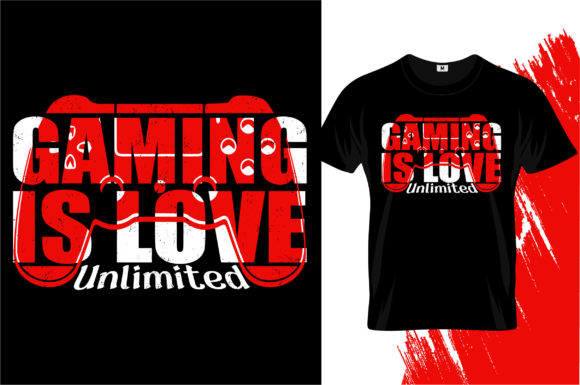
For many, gaming is a profound passion—a boundless form of love for storytelling, competition, community, and artistry. The “Gaming is Love Unlimited” t-shirt design captures this sentiment in a bold, graphic form. It’s a statement piece for players, creators, and fans. However, when you acquire such a design file, often marketed as a ready-to-use asset for merchandise, it’s easy to overlook critical details that separate a successful project from a frustrating one. Understanding what you’re really getting, and how to use it properly, is essential.
The Promise and Potential of Vector Design Files
When you see a listing offering an EPS, SVG, and high-resolution PNG for the “Gaming is Love Unlimited” t-shirt, it’s promising a versatile toolkit. The description highlights key features: 100 vector shapes, easy color changes for dark garments, and applicability for prints on t-shirts, mugs, posters, and more. This isn’t just a static image; it’s intended as a foundational design asset. The allure is strong for entrepreneurs looking to start a merch line, hobbyists creating gifts, or even established businesses expanding their product range. The idea is that you get a professional-grade, adaptable file and can immediately begin production. But this transition from download to final product is where many stumble.
Common Oversights When Evaluating Design Files
One of the most frequent mistakes is conflating file types and their purposes. The package typically includes an EPS (or AI source file), an SVG, and a PNG. Each serves a distinct role. The PNG, at 4500×5400 pixels and 300 DPI with a transparent background, is a fantastic ready-to-print file for many basic applications. However, relying solely on the PNG forfeits the main advantage: adaptability. The vector files (EPS and SVG) contain the design as constructed from shapes and paths, meaning they can be resized infinitely without quality loss and, crucially, colors can be altered. If you only use the PNG on a dark t-shirt without adjusting the color palette as suggested, you might end up with a design that doesn’t contrast properly, appearing washed out or unclear.
Another misunderstanding revolves around the term “100 vector shapes.” This indicates the design’s complexity and structure, but it doesn’t automatically guarantee ease of editing for someone without graphic software experience. To change colors or resize intelligently, you need access to and basic knowledge of a program like Adobe Illustrator or a free alternative that supports vector editing. Assuming you can simply “drag and drop” the file into any online print service without preparation often leads to suboptimal results.
Practical Advice for Using Your “Gaming is Love Unlimited” Assets
Before you even download the ZIP file, consider your end goal. What product are you creating first? A t-shirt? A sticker? This decision influences which file you prioritize and how you prepare it.
Step 1: Proper Extraction and Inspection
The note about extracting the ZIP file using WinZIP, WinRAR, or simply double-clicking is more than a trivial instruction. Compressed files can sometimes corrupt if not extracted correctly, or you might accidentally try to use the ZIP file itself in a design tool. Always extract all files to a dedicated folder first. Then, open them. Use a vector program to inspect the EPS or SVG. Check the layers or groups. Is the design organized in a way that makes sense? For the “Gaming is Love Unlimited” design, verify that elements are indeed separate, allowing for the promised color changes. This initial audit prevents surprises later.
Step 2: Strategic Color Modification for Different Products
The advice about easy color change for dark t-shirts is a direct solution to a common print issue. On a white or light garment, the default design colors might work perfectly. On a black shirt, you need higher contrast. In your vector software, select the background or key elements and change them to a lighter, vibrant hue. This isn’t just about aesthetics; it’s about product usability. A low-contrast print on a dark shirt may be barely visible, disappointing your customers or rendering your gift ineffective. Experiment with color combinations in the software before sending anything to print. A good approach is to create two versions: one optimized for light backgrounds and one for dark backgrounds, saving them as separate PNGs for production.
Step 3: Choosing the Correct File for Your Print Method
Communicating with your printer or understanding your own printing equipment is vital. Many commercial print-on-demand services or local print shops prefer specific formats. While SVG is excellent for web-based systems or laser cutting, EPS is a industry-standard for professional graphic production. The high-res PNG is a safe, universal backup. Always confirm with your manufacturer which file type yields the best results for their specific process (e.g., screen printing, DTG, heat transfer). Sending the wrong file can lead to blurred edges, color mismatches, or outright rejection of the job, costing time and money.
Beyond the T-shirt: Maximizing the Design’s Versatility
The listing mentions the design is ready for mugs, stickers, apparel, posters, and more. This is true, but each application demands slight adjustments. For a mug, consider how the design wraps around a curved surface; you might need to test a scaled version. For a small sticker, ensure intricate details from the 100 vector shapes don’t become too fine to cut or print clearly. Resizing in your vector program lets you adapt the design precisely for each product type without degrading quality. A mistake is to use the same 4500×5400 PNG for everything, which might be unnecessarily large for a web store thumbnail or too low-resolution if scaled up beyond its pixel dimensions for a large poster. Use the vector source to generate purpose-sized PNGs.
Finally, consider your audience. The “Gaming is Love Unlimited” t-shirt design resonates with a broad community. If you’re selling products with this design, understanding that resonance is key. But also, ensure your technical execution—the print quality, color suitability, and product fit—honors that sentiment. A sloppy print on a cheap garment undermines the message. By treating the design files as a professional toolkit, inspecting them, adapting them thoughtfully, and choosing the right output for each purpose, you transform a downloaded asset into a genuine, high-quality product that truly celebrates the unlimited love for gaming.