The Digital Arena: Navigating the Landscape of Online ESports and Gaming Tournaments
Online ESports and Gaming Tournaments represent a structured, competitive layer within the broader gaming ecosystem. They are organized digital competitions where individuals or teams compete in specific video games, often for prizes, recognition, and ranking. Unlike casual online play, these tournaments are governed by formal rules, schedules, and adjudication. What makes them distinct is their deliberate infrastructure: registration processes, bracket systems, live streaming integrations, and dedicated community engagement. This transforms a game from a leisure activity into a spectator sport and a professional pursuit.
Core Components and Organizational Models
The foundation of any Online ESports and Gaming Tournaments platform lies in its ability to manage several core components seamlessly. First is participant management, handling sign-ups, team rosters, and communication. Second is the tournament lifecycle, from bracket generation and match scheduling to result reporting and dispute resolution. Third, and increasingly vital, is content presentation, including live scores, standings, and integration with broadcast feeds.
Organizational models vary. Some tournaments are open, community-driven events hosted by passionate individuals using basic tools. Others are closed, invitation-only leagues run by game developers or major brands with sophisticated, proprietary platforms. The middle ground is occupied by organizations using specialized tournament software or custom web platforms to host recurring competitions for a growing audience.
Key Decision Factors in Platform Selection
When evaluating how to host or present Online ESports and Gaming Tournaments, several practical factors come into play.
- Scale and Frequency: Are you organizing a single annual championship or a weekly series of smaller events? High-frequency, smaller-scale tournaments demand efficient automation, while monumental annual events prioritize grandeur and one-time user experience.
- Technical Integration: How deeply do you need to connect with game servers, anti-cheat software, or streaming platforms like Twitch or YouTube? Some solutions offer APIs and deep integrations, while others are more presentation-focused.
- Community Management: Does your platform need built-in forums, chat systems, or team coordination tools? The social layer is often as important as the competitive layer for community retention.
- Monetization and Sponsorship: Consider how you will handle entry fees, prize distribution, and sponsor visibility. The platform must support these financial and promotional workflows transparently.
The Role of Presentation: Website Templates as a Strategic Tool
For many organizers, the public face of their Online ESports and Gaming Tournaments is a website. This site acts as a hub for information, registration, live results, and media. The choice of how to build this site involves a tradeoff between custom development, generic CMS themes, and specialized web templates designed for gaming and esports.
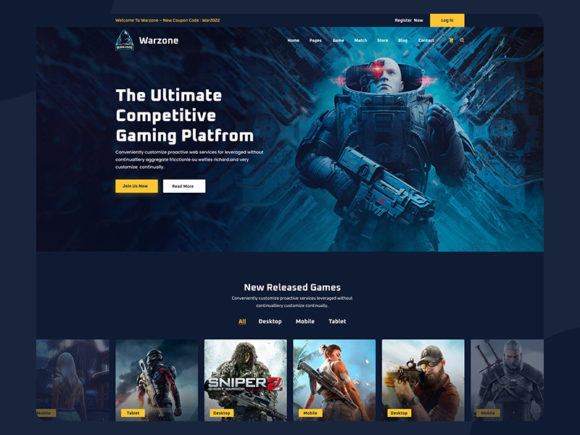
Specialized templates, such as those offered for crypto games or modern esports designs, provide a significant head start. They are pre-configured with layouts suited for tournament brackets, player profiles, news blogs, and event calendars. Their primary strength is time-to-launch and visual cohesion. A well-organized Figma template, for instance, allows for rapid prototyping and clear communication with a developer or designer, as files are logically structured and named.
Evaluating a Template's Fit for Your Tournament Needs
A template is not a complete solution; it is a foundation. Its value depends heavily on how well its predefined components align with your tournament's unique requirements.
- Design Priorities: Does the template emphasize real-time data display, which is crucial for live tournaments? Or is it more focused on static team pages and historical archives?
- Customization Depth: "Easy to customize and update" is a common claim. In practice, this depends on the underlying code structure. A template built with modular components and clear documentation truly enables adaptation without starting from scratch.
- Feature Alignment: Compare the template's showcased features—like countdown timers, match brackets, or streaming video panels—against your mandatory feature list. An eye-catching design is beneficial, but it must contain the functional widgets your operations require.
If you are launching a website for a defined game plan with a standard tournament structure, a tailored web template can be an efficient choice. It avoids the cost and time of fully custom design while providing a genre-appropriate aesthetic. However, if your Online ESports and Gaming Tournaments involve novel formats, complex multi-game circuits, or deep data visualization needs, a template may become a limiting constraint, requiring such extensive modification that a custom build becomes more sensible.
Strengths and Tradeoffs of a Template-Based Approach
Choosing a specialized web template for your Online ESports and Gaming Tournaments website presents a clear set of advantages and compromises.
Strengths include:
- Speed: Deployment can be dramatically faster than a ground-up design process.
- Cost-Efficiency: It typically represents a lower initial investment than hiring a designer for a unique project.
- Genre-Specific Design: You benefit from design decisions made by specialists in gaming aesthetics, which can enhance credibility and user engagement.
- Focus on Content: With the layout largely solved, you can dedicate more resources to creating tournament content, rules, and community updates.
The tradeoffs, however, are important to consider:
- Potential for Generic Appearance: If the template is popular, your site may visually resemble others, diluting brand distinctiveness.
- Functional Limitations: The template dictates the possible user interactions and data presentations. Unusual tournament formats might not fit neatly into its pre-built modules.
- Future Scalability: As your Online ESports and Gaming Tournaments grow, the template's architecture may hinder adding new, complex features without a major overhaul.
- Integration Challenges: Connecting the template to specialized backend tournament management software may require custom development work, negating some of the initial ease.
When is a Dedicated Gaming Template the Right Choice?
A modern gaming web template is likely the right choice in specific scenarios. Firstly, for new organizations or indie tournament series where budget and time are constrained, and establishing a professional online presence quickly is paramount. Secondly, for organizers running tournaments within a single game or a narrow genre, where the template's focused design language directly resonates with the audience. Thirdly, when the primary goal is clear information dissemination and registration, rather than complex interactive experiences.
Conversely, you may need another option if your project falls outside these parameters. Consider custom development if your Online ESports and Gaming Tournaments are a core revenue driver for a large business, requiring unique branding and proprietary functionality. Also, if you are building a platform meant to host tournaments for hundreds of different games dynamically, a generic template will almost certainly be inadequate. In such cases, a more flexible, content-focused CMS with heavy customization, or a full custom application, becomes a necessary alternative.
Balancing Presentation with Operational Reality
It's critical to remember that a website, even a beautifully designed one, is just the front end. The success of Online ESports and Gaming Tournaments hinges equally on robust backend operations: rule enforcement, fair play adjudication, timely communication, and prize fulfillment. A template helps present these operations professionally, but it does not execute them. The most effective organizers select tools—whether templates, software, or services—that create a harmonious link between a compelling public presentation and a smooth, trustworthy operational backend.
Ultimately, the decision revolves around alignment. Does the template's vision of how Online ESports and Gaming Tournaments should be presented match your vision? Does its structure facilitate your workflows? By evaluating it not just as a design, but as a functional framework for your specific competitive events, you can make a more informed choice between leveraging a pre-built solution and investing in a custom path.